
What Does An Accountable Government Look Like to You?
Summit 250, a convening from a few weeks ago, led to a great set of discussions and next steps from a host of people who are working for reconstructing government.

Editor’s Note: A few weeks ago, I mentioned I would be participating in a 2-day workshop focused on a responsive, accountable government. I’m excited that today’s Next Interior Memo is from Dr. Christina Cromley Bruner, Co-founder and Executive Director, For 250 More, and Vice President, Society of Policy Scientists, who led organizing the Summit, providing an overview of what was discussed and its relevance to Interior’s future.
Getting motivated and the flow of the conversation
What does it mean to have an accountable government? How do we achieve it? At this critical time in our Nation’s history, answering these questions is essential for American society, including the Department of the Interior’s stakeholders. And these two, closely related questions guided the discussions at Summit 250, convened by the organization For 250 More and the Society of Policy Scientists in Washington, DC on November 14th and 15th. Founded in 2025 by former federal employees dedicated to fighting fraud, waste, and abuse, For 250 More is uniquely positioned to lead dialogue about accountability.
Panelists and participants from the civic, government, academic, and private sectors discussed how a nonpartisan civil service and independent oversight enable accountability in government. Safeguarding them requires public engagement.
To provide a common understanding of what is happening to the civil service, Summit 250 welcomed two esteemed panelists to kick off Day 1: Max Stier, President of the Partnership for Public Service, and Rob Shriver, Managing Director of the Civil Service Strong initiative at Democracy Forward. They discussed the role of civil servants in delivering public services; public servants’ ability to solve problems within a complex landscape of laws and regulations; and the need for greater accountability of political appointees. Key insights from the panel included:
- The federal government lost 300,000 employees to reductions in force, incentives to resign and retire, and shuttering of entire functions and agencies, amounting to a loss of 3.7 million years of experience.
- This loss significantly reduces the government’s capacity to solve problems and deliver services, because career civil servants possess unique institutional knowledge to operate the country’s most complex organization.
- There is an opportunity to elevate appreciation for federal employees by sharing their stories, expertise, and dedication to serving the public and improving life in America.
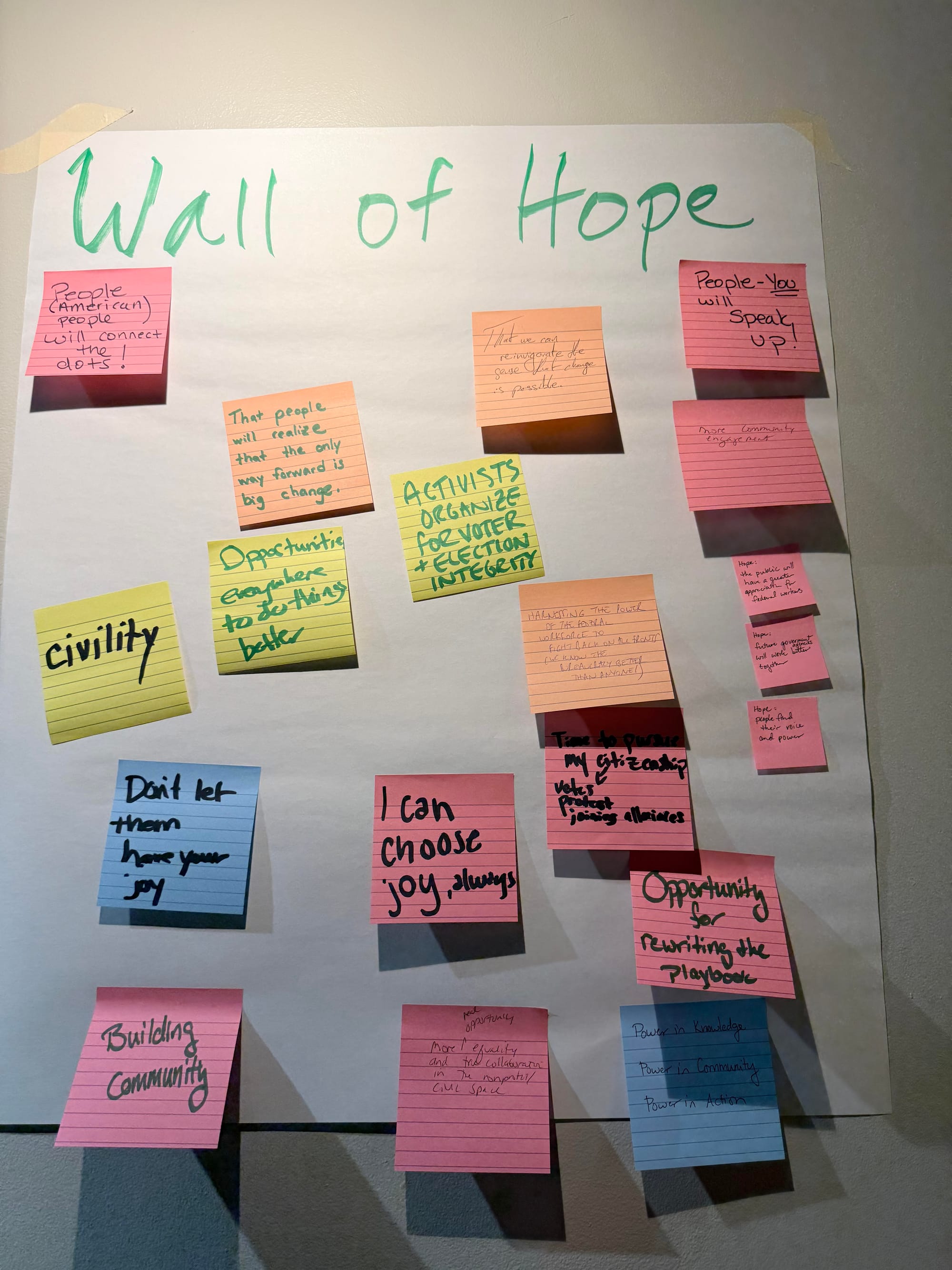
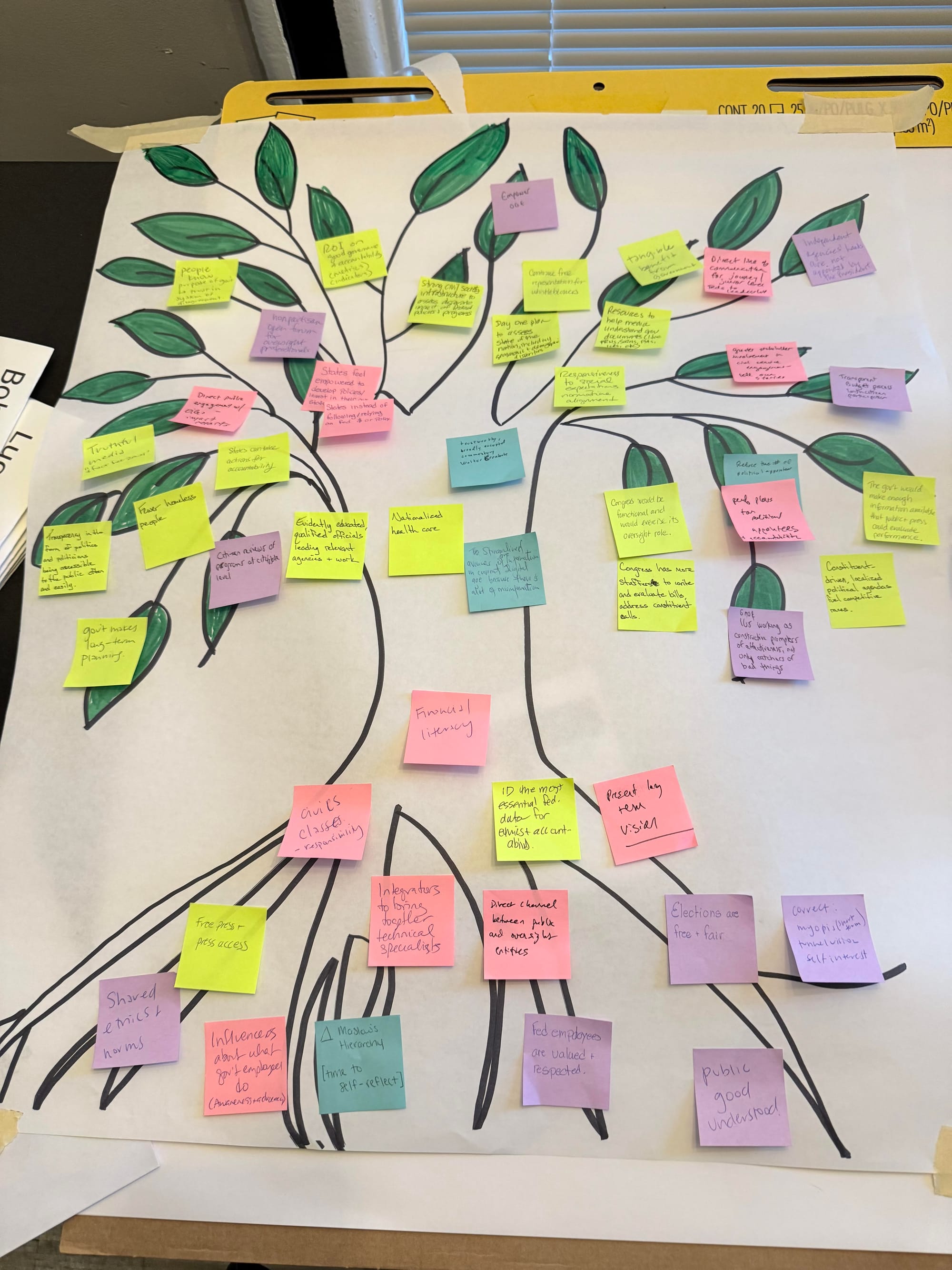
Summit participants then broke into small groups to answer two questions: If you woke up tomorrow in a future where government was held accountable and public officials act ethically and effectively for the public good, what would it look like?; and What support, information, or resources can facilitate ethics and accountability in government?
Common themes emerged: the importance of defining common ethics and values, and holding officials accountable to them; engaging in long-term thinking; and expanding capacity and opportunities for civic engagement and community building.
Friday afternoon, oversight experts discussed the connection between oversight and effective government. Moderated by former Inspector General Bob Westbrooks, panelists included David Eichenthal, author of The Art of the Watchdog; Mark Lee Greenblatt, former Inspector General for the U.S. Department of the Interior; New York State Inspector General Lucy Lang; and former Comptroller General of the United States Dave Walker.
Panelists assessed how independent oversight should function compared to how it is functioning. The discussion highlighted the stakes for the future of democracy:
- Open discussions of public corruption in the United States signals a healthy accountability system—like an indicator species in ecological systems. Oversight leaders must be able to criticize and disagree publicly with an administration—an openness uncommon in foreign countries.
- Dismissals of IGs without cause—or even worse, for being critical of the administration—jeopardizes their ability to openly criticize the administration and to fight fraud, waste, and abuse, undermining accountability to the people.
- Lack of public outcry over the firing of IGs suggests limited public understanding of their vital role as a safeguard against corruption and abuse of power. Oversight leaders stressed the importance of making “inspector general” synonymous with democracy.
All is not lost. Summit participants reconvened on Saturday to chart a path forward. They committed to slowing and reversing the erosion of safeguards and to strengthening the government’s ability to serve all Americans. They set a goal of working together to educate the public and to expand participation in the search for common interest solutions. The strongest consensus was around national dialogues, creating spaces for Americans to reaffirm values such as freedom, independence, and ensuring the same rules apply to everyone, and renewing the norms and systems that protect those values.
A Case Study from Interior Provided a Model for How This Can Work
While this discussion might seem abstract or relevant only at the national level, I argue the opposite. A case from decades ago at the Department of the Interior demonstrates how these themes play out locally and regionally.
As part of my doctoral research, I studied the public outcry following the Wyoming Game and Fish (WYGF) Department’s decision on August 4, 1996 to kill Grizzly Bear 209. The incident demonstrates how public sentiment can shape accountability, which is not always about legal violations or punishments. It is also about how public officials respond when their actions conflict with expectations in law, policy, or norms. Signals of misalignment may come through many forms, including formal reports, public dialogue, or other mechanisms.
Bear 209 was a known troublemaker. He had a history of depredating cattle and being relocated, and in the weeks before his death, helped himself to eleven calves. Under the “three strikes” policy at the time, this meant euthanasia. For the WYGF Department, it was irrelevant that the third strike was in Grand Teton National Park. For the public, it mattered deeply. The local media condemned the decision, and more than 800 people—in a community with 5,000 residents —signed a petition demanding that wildlife take precedence over cattle inside national parks.
Dialogues ensued among key stakeholders on how to handle grizzly-cattle interactions on public lands and other wildlife-human interactions. Those dialogues clarified normative expectations and led to policy solutions. A study was initiated to document bear behavior patterns and interaction with livestock to gather information that would help officials better balance wildlife preservation with the needs of ranchers. The family who owned the rights to graze cattle in the park ended their leases in 2001.
Concluding Thoughts
Like the response following the Bear 209 incident, daily public outcry, IG reports, court rulings, and other public reports and statements are sending clear signals that dozens if not hundreds of official actions are misaligned with law, policy, norms, and public sentiments.
Engaging the public in an effective response to these signals will take ongoing effort, active listening, and funding. Whether that funding comes through creative new monetary solutions or significant investment from philanthropies, we need more equitable distribution of resources among the many dozens or hundreds of organizations working toward a better, shared future. That includes money and less tangible resources such as power and access to those in power. This is not my insight—this theme emerged strongly among summit participants.
As former federal employees from the oversight community, the founders and Board of For 250 More are excited to strengthen our partnerships with groups such as Next Interior and others. We need more dialogues like the ones that took place at Summit 250; by expanding the circle of participants, we can build stronger safeguards and greater public accountability together.
This article is just an initial overview of the Summit! To follow along with more details from the Summit as they are released, and as other work is convened, be sure to subscribe to the For 250 More Substack:
 Substack