Next Interior Memos weekly digest, 2025-11-20
Water and imperiled species, fire science and risk, Tribal reports, and more this week

It’s the week before Thanksgiving Day and there are many things going on with the Department of the Interior. (And we’ll be taking a break from the digest next week on account of the holiday.) We won’t try to cover all of what’s happening, but will share an upcoming webinar, some news around each of Interior’s mission areas, a few cross-cutting topics—including a post that Tony Irish shared on some DOI staffing news—then a photo to cap it off.
Next Interior Fellows webinar
Back in September, we introduced our inaugural Next Interior Fellows, Adam Auerbach and Vanessa Raymond. Now, we’re excited to spotlight their work, check in on their progress and hear their insights in our December 9 Next Interior Fellowship webinar!
Vanessa is bringing Alaskans into the studio to discuss critical minerals & the future of technology, society, and energy together on her weekly radio show, Them Thar Hills, on KSUA 91.5 FM (Fairbanks). She is also crafting an important resource which will synthesize DOI actions, guest & public feedback, and Arctic and Pacific voices from the show to inform future engagement and critical minerals policy decisions.
Adam is supporting Next Interior’s work around visioning DOI’s future by holding listening sessions with partner organizations, academics, stakeholders, and rightsholders who have an interest in rebuilding a strong and effective DOI. Findings from Adam’s interviews will inform the Interior-focused Institutional Knowledge Project, which primarily involves conversations with departing DOI staff. Collectively, these insights from internal and external partners will inform Next Interior’s recommendations for how and where to most effectively rebuild DOI in the future.
Want to learn more about Adam and Vanessa’s important work, ask questions, and hear their insights? Join us on 09 December 2025, 3pm ET / 12pm PT. Register here:
Natural and Cultural Resources
Coming out of the shutdown there are several regulations from Interior and beyond that fundamentally affect—will cut against—the Department’s mission to “protect and manage natural and cultural resources” and the underlying legal requirements to do so. Here are a couple of the big ones this week:
- The Trump EPA is proposing to dramatically weaken the Clean Water Act by reducing the scope of the Waters of the United States (WOTUS) through a revised regulation. Like an 80-85% reduction in covered waters and wetlands, somehow pretending that waters aren’t really connected (???). Waters that need to be clean for people, to which many Tribes have specific rights that the US must meet, that need to exist for wildlife from birds to endangered species...in other words, big implications for Interior’s ability to meet its obligations to the country under the law. This is nothing but bad news for people and nature, and I discuss them a bit more here. A strong WOTUS rule that respects the public’s needs for clean water and advances Interior’s legal obligations would take a broad understanding of the interconnections of water!
- The Department, through the US Fish and Wildlife Service, is back at it with gutting Endangered Species Act (ESA) regulations. These changes do not follow the intent or letter of the law! The purposes of the ESA are preventing extinction and recovering species, and weakening how federal agencies make decisions about how to do that does not help. The law is clear that listing decisions are to be based only on scientific and commercial data; adding in economics is clearly disallowed. Other groups with deeper benches for ESA analysis will get into the details in coming weeks, and I’ll share those as they become available. I’ll just note that a strong future ESA will do more to emphasize the affirmative direction to conserve species by federal agencies and would improve private lands conservation tools…but those are deep dive topics for another day.
But let me leave you with some good news. The Keep Public Lands Public Act got a boost with the endorsement of the Bipartisan Public Lands Caucus this week. The Caucus came together earlier this year with the renewed assault on public lands from the administration and people like Sen. Lee of Utah, and it’s good to see this step for keeping public lands public.
Science and Knowledge
This week I wanted to highlight a brief item from a couple of fire ecologists that a reader (thanks JB) shared with me and that is really important for Interior’s work. The main message in this one-pager is that land managers need to be less risk-averse.
There's a lot to agree with in that sentiment, at least based on my experience both working on the land management side with the Fish and Wildlife Service (including having spent time doing both prescribed burns, e.g., with the National Park Service and Forest Service and with suppression of small wildland fires) and from the policy / management side in Interior. Yes, we definitely need to address current norms of risk aversion, but this isn't all risk aversion. One particular statement from the piece suggests a fundamental misunderstanding of the challenge:
...we need to ask two questions—what a priori management could have altered the severity of the consequences, followed by why was that management not implemented in the past decade? If the answer to the first question is that a management activity could have moderated the effects of the wildfire and the answer to the second question is anything other than “insufficient funding”, we need to require that management unit to undertake a thorough review of their actions.
To me, this suggests the authors haven't been the managers who have had to deal with / don't really understand the multidimensional challenge of land management. (All apologies if they have been land managers and that didn't come through.)
Their flag of "insufficient funding" glosses over yet is fundamental to and embedded across issues, so it's a crucial but not all-explaining secret key. Funding doesn't really address the risk that forest or land managers are threatened with arrest by local sheriffs who have no idea of land management needs (or, more generally, the complexities of public engagement). It doesn't resolve the need to manage for a variety of wildlife, including ESA-listed species, with different responses to fire. Funding doesn't address the fundamental barriers to returning cultural fire--burning as Native Americans did for millennia to great effect--to the landscape. There are other mandates of course, these are just a few that quickly came to mind...you get the point.
There is a mechanism / framework to analyze and manage the broad challenge, Enterprise Risk Management, which they don't mention once. While managers do this balancing locally and largely by instinct and training in a loose sense, institutionally, Interior and Congress are terrible about it have lots of room to develop their skills considerably. With an ERM approach that includes the risks, rewards, constraints, and trade-offs across outcome topics (legal, regulatory, and / or moral imperatives), we might be able to actually understand and then address the incentive structures that hinder substantive progress. There are cultural barriers to taking an effective ERM approach, however, like fear of punishment if a reasonable risk (like a particular prescribed fire) doesn't pan out quite as planned, rather than a culture of learning and adapting based on the evidence and the risks.
I understand that facts don't always win the day 😁, but I have to believe that systematically accounting for the manifold requirements and risks and then introducing risk treatments--including treatments that incentivize reasonable risk-taking--across the enterprise is the only realistic way to get better outcomes. Fire is an important issue but it's not the only issue land managers have to account for. My hope is that a future Interior (and Forest Service) gets better at these things so we do better!
Tribal matters
While the initial action in this item happened months ago, the fact that it has not been fixed is news: the Trump administration’s removal of the Not One More report on Missing and Murdered Indigenous People. The preceding link is to a copy of the report, so it hasn’t been completely lost, but that doesn’t really matter: the report is required by law and the justification for the takedown—that it represents Diversity, Equity, and Inclusion (DEI) work—shows just how ignorant the administration is. Tribal matters are not DEI: tribes and their members are a political class with specific rights guaranteed by the Constitution and through Treaties and law. As bad as this administration’s understanding of DEI is—or rather, they understand that elevating DEI is a means of granting marginalized people power that they’ve been deprived of, so the administration is opposed to that—treating Tribes as a race or social class is particularly absurd and ignorant.
Cross-cutting issues
Two main items to put on your radar, one directly relevant to Interior and the other generally relevant to the federal workforce—so, including Interior. First, this morning Tony Irish did a more detailed look at the news from GovExec that Secretary Burgum is charging Interior’s bureaus more for the bureau employees they’re moving to the Office of the Secretary. I’ll embed Tony’s post here; folks reading on email will want to go here.
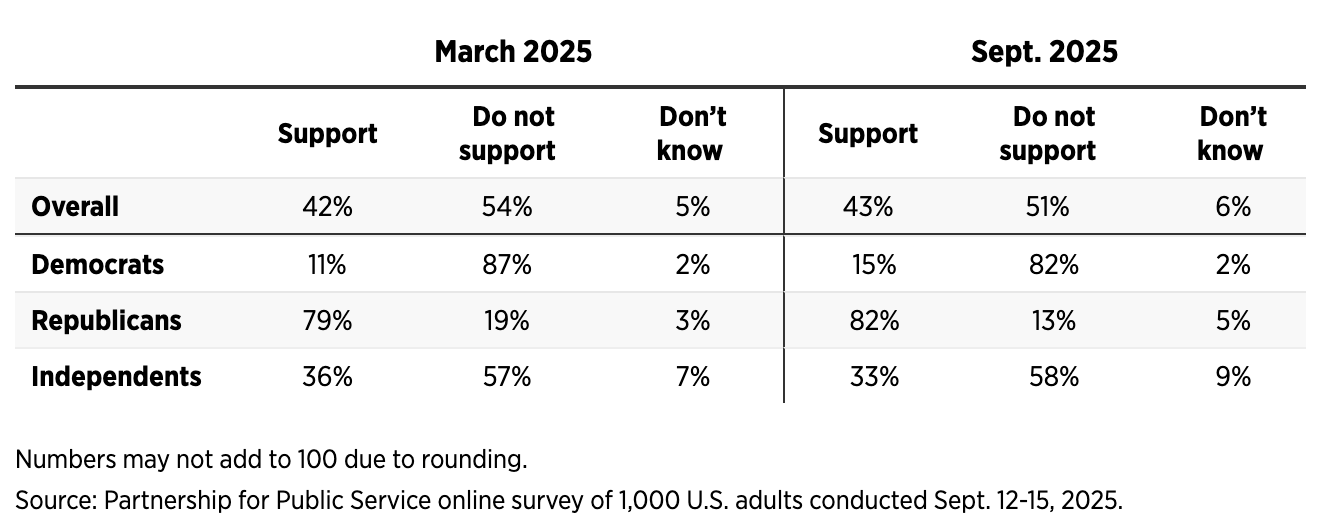
Second, really important data out of the Partnership for Public Service this week…well, important and a bit concerning. Their top-line is, “The public is noticing the impact of the Trump administration’s cuts to the federal workforce and government programs.” That’s good, because we need people to notice! But then…well, there are some problems. The percentages of people concerned about the cuts and support / do not support is essentially unchanged since March:
When you start to get into details—like specific programs or Departments or issues—you see things like 40% of people who support the cuts believing it will harm the economy.
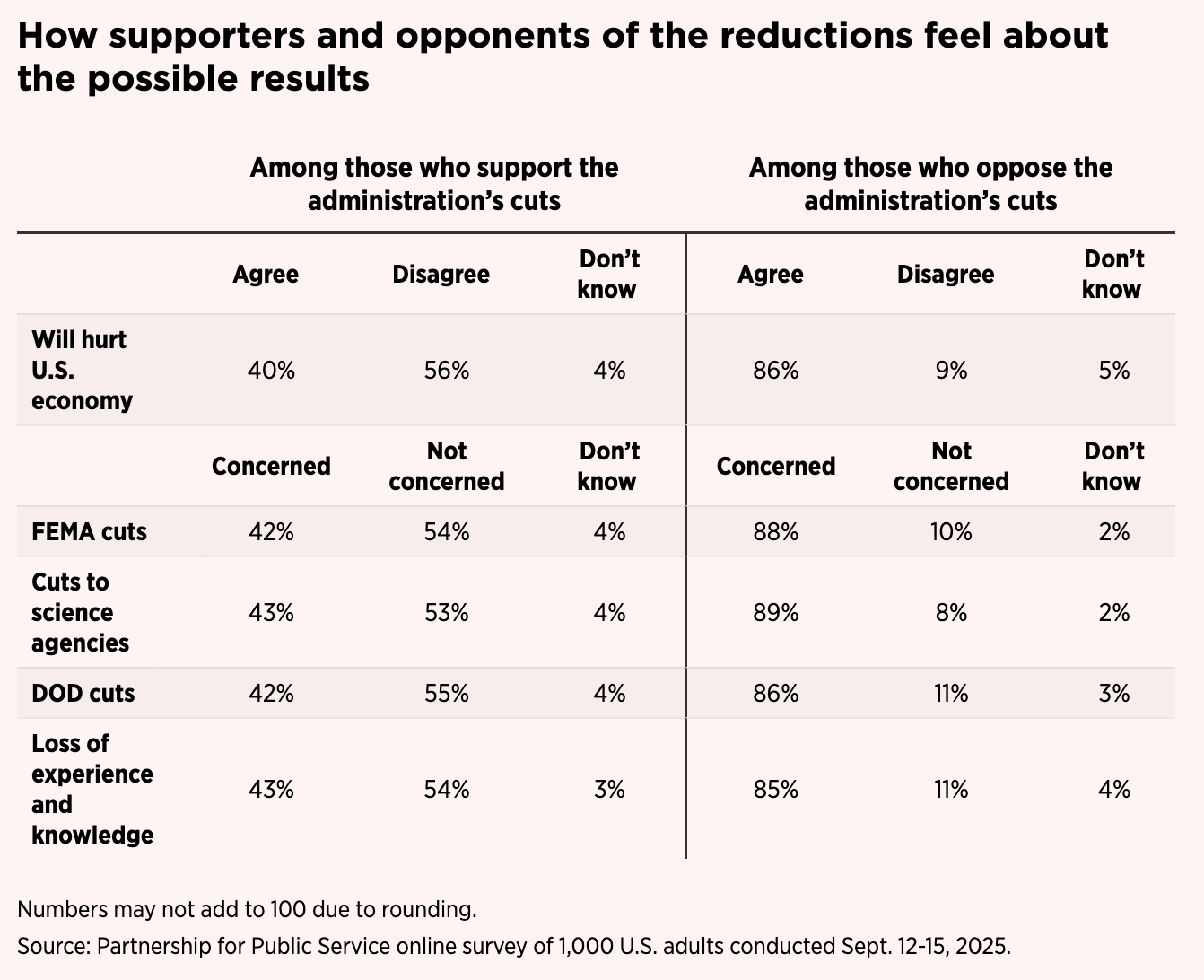
Go read the details over at the Partnership for Public Service.
The reality is that we can’t have a strong US Department of the Interior that is fully able to serve the public and do everything the public expects if there isn’t public support for the civil service! (And no, the push for 500 new law enforcement for the National Park Service doesn’t count, and really will not address the needs of the parks and people.) It’s going to take a lot more work to shape public opinion and get us back on a better track.
Semi-random read
Some folks know that a critical read of mine from the past couple of years was Elizabeth Sandifer’s Neoreaction: A basilisk, which is a deeeeeeep dive into the people and “philosophy” of the fascism wing of the technology world. I found it super enlightening and super creepy, but reading it in early 2024 helped me make sense of what’s happened with the Trump-tech-fascism alliance. Well, this week she published a good article on “Artificial General Intelligence” and why it’s a pipe dream that’s unconnected from anything that is available today (like Large Language Models). No, this is not about Interior or natural resources in any direct way! But I think it is helpful for thinking about the future and what it could mean for Interior as factors far beyond the Department shape its work, like energy, lands, climate, and more in the pursuit of AI/AGI.
Parting shot