
It’s past time to rescind the Congressional Review Act
Here’s a concrete proposal to undo a bad law used to do bad things through a bad process

Things have been pretty quiet here in part because I’ve been working on a variety of policy ideas with key folks to try to move those forward. I may share some of those ideas here or elsewhere, some may be best to have partners lead with, some may ultimately not see the light of day…we’ll see. But one to share now is about a long-problematic issue coming again to the fore, given congressional Republicans’ attack on Boundary Waters specifically, and their general abuse of deliberative process in general through the Congressional Review Act, or CRA. The only reasonable course of action is to rescind the CRA.
Call your Senators today (especially Republican Senators) to insist they vote “No” on the Boundary Waters minerals withdrawal CRA resolution. The proposal in this Memo is a long-term solution but there is an immediate need for action to protect this amazing wilderness! Click this button for a quick and easy way to take action:
The CRA is bad law
If you haven’t been following the details (and I hope you have been doing more productive things!), Congress passed the CRA during Nude Getrich’s Newt Gingrich’s reign in the 1990s. The law allows Congress to pass a “resolution of disapproval” stating it doesn’t like a rule a federal agency has adopted, and once signed into law, the rule is null-and-void. (You can find a brief review from the Government Accountability Office here.) On first glance that might seem fair…it is Congress’s prerogative to legislate after all and the CRA is law!
But the CRA is a bad law, as in, it performs poorly for what the Nation needs from the Legislative Branch:
- Resolutions are passed with a simple majority through a process that precludes any serious debate about the substance of a matter. Further, the process disregards essential expertise that ensures federal rules are connected to reality—little things like understanding how systems really work, whether through operations or science—that civil servants and the institutions bring to the table. That alone should be an alarm bell for everyone…these are serious matters that deserve serious attention!
- The use of the CRA completely bypasses direct public involvement in the rules that affect our lives, environment, economy, and more. That kind of direct involvement is critical to a healthy democracy, but when Congress rescinds an agency rule—each of which goes through extensive public comment, hearings, meetings, deliberations before adoption (assuming the process is not pro-forma)— they mute our voices and short-circuit the will of the governed.
- Every bit as bad—and a point that gets a lot of attention—is that it prohibits an agency from issuing a “substantially similar” rule after a disapproval unless Congress acts (which, of course, does not have an expedited path). What is “substantially similar?” Well, that’s left as an exercise for the reader because it’s not defined, and there’s little or no agreement on what it might mean.
As a result, we end up with situations like what has occurred repeatedly in the current Congress (and past Congresses), with CRA resolutions that rescind anything from general regulations that agencies need to implement congressional direction to specific public lands management plans that often took years and massive investment and community engagement to create. Just gone, with wide-reaching consequences but little or no deliberation. To use the management plans as an example, those public lands now have to be managed by ancient management plans that are woefully out-of-date. Worse, the Bureau of Land Management (or whichever agency gets targeted by a CRA resolution) cannot craft a new rule to try to address Congress’s ire because it’s probably going to have to be “substantially similar” to address management needs.
So, again, the CRA is just bad law. It may make it easy to get quick headlines from members of Congress about how they’re working to “shrink” government, but that’s just a sham, the equivalent of a get-rich-quick scam where a few people “win” and everyone else loses. We need and should demand that our elected leaders do the hard work of substantive policymaking and legislation.
Repeal, don’t amend the CRA
So let’s repeal the CRA! Doing so would:
- Return the country to having Congress use its policymaking powers in a healthy manner that serves people’s needs.
- Return us to a process and structure in which people have a direct say in the rules and regulations that shape our lives locally and broadly.
- Offer a chance for restorative actions—let’s undo some of the past damages from the CRA and have a solid process to do so.
Repeal would not:
- change Congress’s ability to legislate on matters they don’t like, but it would require the institution and our elected members to use the regular deliberative process of legislating to do their job.
- stop Congress from “shrinking” government if that is what their constituents want; they just need to use their regular legislative processes.
- stop members of Congress from doing politics around an issue…feel free to make political hay, and let it be part of the process of accountability!
Amending the CRA is a bad idea. No amendments would fix the flawed, fundamental assumptions or consequences of the CRA. And an amended law would be superfluous: the Constitution grants Congress the authority to make and pass laws already!
A concrete proposal
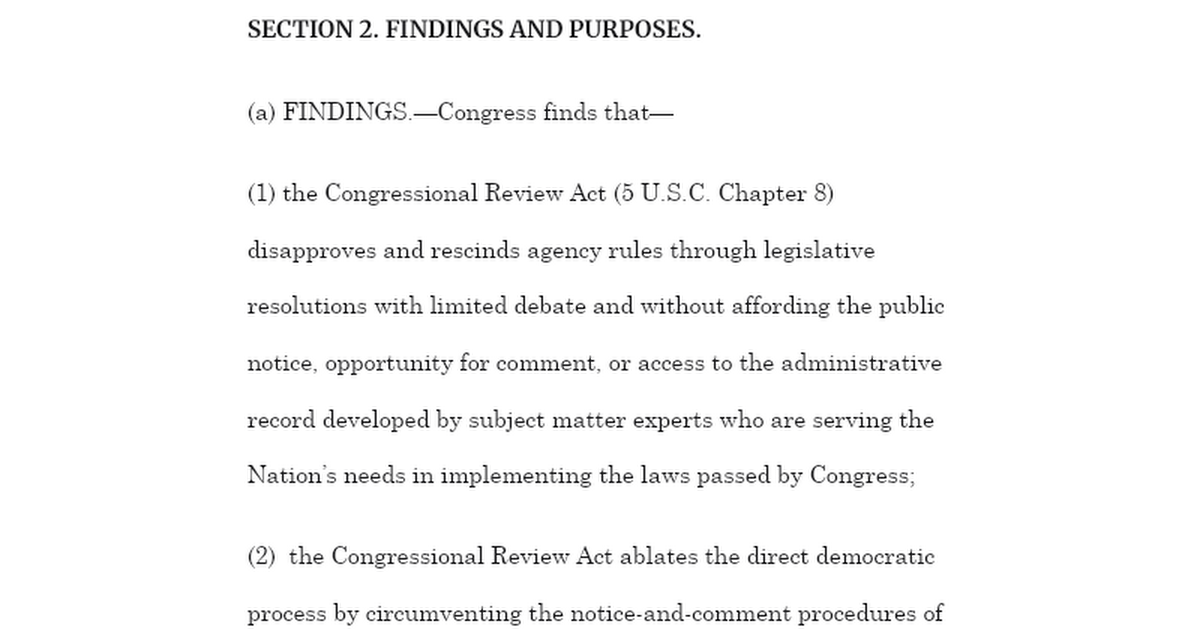
What would repeal look like? How about this draft bill (and here’s the bill summary), which would do just that! Not only that, this bill proposes that we take restorative actions including rescinding all past resolutions of disapproval, reinstating the rules that were declared void, and directing agencies to analyze and report to Congress how they will make things right (and would authorize appropriations for agencies to have the capacity they need to do this). Is this draft perfect and refined? Nah, but I hope it starts a real conversation by making a concrete proposal.

There would be lots of ramifications for the future of the Department of the Interior, both in terms of the future ability of the agency to actually implement the laws Congress has passed, and restoring rules and other actions that have been previously rescinded. It will mean that people can avail themselves of public engagement processes to shape the federal rules that shape their lives, whether it’s a big, national regulation or a local land management plan.
We may not know all the answers and all the ramifications yet, but a return to the regular order of policymaking by Congress has to be better than what we have now, and it is essential for a better future for Interior.
Footnotes
- The astute reader will see a note at the end of the draft bill a “Generative AI disclosure and offset” statement. Those who know me and who have read various articles here know that I’m extremely skeptical of genAI, believing that the harms to people (e.g., real, creative, human jobs lost), knowledge (e.g., the plague of mis- and dis-information), and the planet (e.g., energy, water, habitats, and more) are very large and completely unaccounted for—what economists would call externalities. But I’m not a lawyer and didn’t have resources to pay one to help turn the policy positions into legislative language, so I decided to use Kagi Assistant and then made donations to three organizations working on the specific harms caused by AI.
- I encourage everyone to try Kagi. It’s a fantastic service with great search—far better than the alternatives—and other tools that is funded by subscriptions rather than advertising, does not force genAI answers on users, and they're actively working to avoid and reduce AI slop. Some will complain about paying but (a) you get nice things when you pay, and (b) if you're not paying, you're the product.
- This post, as with all Next Interior Memos, is entirely human-written and human-edited.
- No, this will not pass in the 119th Congress, and would likely be vetoed if passed in the 120th Congress. That doesn’t mean we shouldn’t lay out what is actually needed! Further, I’d love to think someone among the supporters of democracy is thinking about that pie-in-the-sky goal of aiming for 2/3rds majority—doesn’t have to be just Dems as long as there’s a caucus of 2/3rds who will override vetos of the authoritarian in the Executive Branch—in Congress! But that’s a topic for another day…
Comments
What do you think? Leave your comments below! Really want to be able to make comments / suggest line edits to collaborate more directly? Get in touch and we'll make that work!